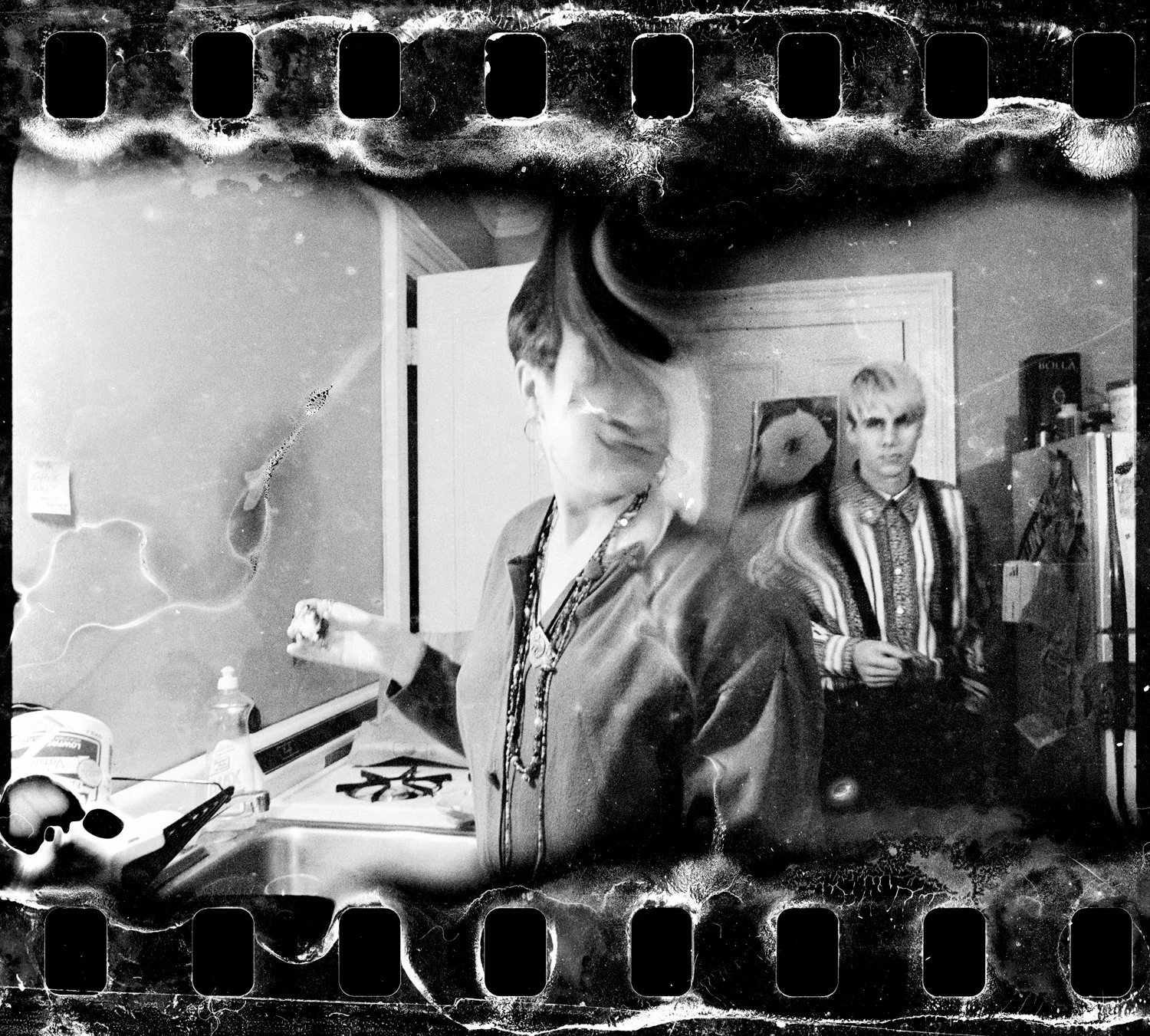
Anna Reed
I originally met Anna Reed at Review Santa Fe in 2024, where she had won CENTER’s Me&Eve Award that year and was attending the reviews. Well, needless to say, she made some waves and really got some people talking about her and her work. I was one of those and finally sat down to conduct this interview with her, because, as usual, I had questions.
There’s something immediately disarming about talking with Anna Reed. Maybe it’s the way she leans into curiosity without over-explaining it, or how easily she moves between the language of materials and the language of lived experience. Either way, you get the sense pretty quickly that her relationship to art is accumulated, layer by layer, much like the work she makes now.
One of the things that I love about Anna, is how she describes her role as an educator almost like being embedded in an ongoing, collaborative think tank. You know, the kind where questions matter more than answers, and where problem-solving is inherently creative. That type of reciprocity is wildly important to anyone in the arts if you ask me.
Anna is deeply interested in the interaction between humanity and technology, particularly the ways our personal devices reshape how we connect, communicate, and perceive ourselves. It’s not a detached, theoretical concern. It’s something she’s witnessed up close, year after year, quite often through the evolving behaviors of her students. The sheer volume of images, the speed at which they’re consumed, and the blurred line between authenticity and performance all feed into her thinking.
But there’s also a more personal undercurrent. Anna talks about her own experience navigating a hyperconnected world with multiple platforms, constant notifications, and the persistent pull of digital life. And beneath that, a question begins to surface: where does the “real” self reside when so much of our existence is fragmented and spread across screens? It’s this tension between presence and absence, connection and isolation, that sits at the core of her work.
So again, oh yes, I have questions. The kind that have me thinking about my own relationship to art and my daily device experiences. Anna Reed’s photographs become a space for exploration, for uncertainty, and for the kinds of questions that don’t have clean answers. And maybe that’s the point. In a culture that often demands clarity and immediacy, her work asks us to slow down, to look closer, and to consider the possibility that the most meaningful insights live somewhere in between.
Phantasiai, from Merging Dimensions
Bio -
Anna Reed is a Chicago-based artist and educator whose work addresses the themes of identity, post-humanism, fragmentation, and the boundaries of virtual space. How and where do we exist? Born into Atari and grappling with AI, she is continually curious about the intersection of humanity and tech. Created through Xerox, scans, and other low-fi devices, she often uses her body as source images. The physical body confronts the screen and pushes the invisible boundary of human, device, and the virtual. She collaborates with machines and platforms alternating decisions as the works move from physical to digital and back again. She is a recent recipient of the Me & Eve Award by CENTER and has exhibited at EXPO Chicago, Griffin Museum of Science and Industry, The Turchin Center for the Arts, and various galleries across the nation. Anna currently chairs the Leyden High School Art Department and is the digital gallery director for Art ConnectED.
Interview -
Michael Kirchoff: I’m excited to finally have this time with you, Anna, as this interview is long overdue. Before we get into specifics about your work and process, I’d love to know about what got you into the visual arts in the first place. Was it always a photography-related introduction, or something more?
Anna Reed: I’m so glad to do this interview as well! Thank you for this time to connect. Art has always been a part of my life, and I have so many memories of my mom, teachers, and artists introducing me to the magic of materials and storytelling through images. In 8th grade, a teacher showed me magazine transfers, and I was mesmerized. I was introduced to charcoal, collage, and large-scale drawings in college, and it changed how I thought about the page. I chanced upon stencils and graffiti while studying abroad in Italy, and layering had a new meaning. A friend once asked me if I was being seduced by materials. Yes! Always! I came to photography pretty late in the game as a byproduct of my first teaching job, but it’s challenged me more than any other medium.
MK: It seems the tactile qualities of artmaking often lure people in. And I was going to bring up teaching later, but since you mentioned it now, I think we should address this a little more. What is it about your role as an educator that keeps you connected to art, especially photographic art? I love that teaching is what connected you to photography.
AR: Being an educator is like being in a constant think tank. I’m surrounded by a group of people asking questions and trying to solve problems with the most creative solution. My students have made me a better artist because we are collectively trying to make work that rethinks a concept or a material. Even when we are on a photo shoot in the same location, I am continually surprised at the way they see the world differently. The pace, quantity, and variety of images digital natives interact with is staggering. They introduce me to new artists and challenge image authenticity. I teach them to slow down and wait for the photo moment. It is often said that you learn the most from your mistakes. As an educator, I get to observe hundreds of “mistakes” a week and help find solutions. Now, much of my work incorporates photographic experimentation and mistakes. In fact, my interest in the intersection of humanity and tech came out of concern in how my students interacted with their devices.
MK: I was not aware that your students helped inspire the work you create as a photographic artist. Can you tell us a little more about this work and why it sits at the forefront of your artistic aesthetics?
AR: I’m exploring the intersection of humanity and technology, with a particular focus on our personal devices. Having a constant computer and social network has profoundly changed interpersonal relationships. As a teacher, I’ve watched this play out with every passing class of students—the duality of being hyperconnected and simultaneously feeling isolated.
In just a few years, I found myself with three social media platforms, two websites, five email accounts, and endless chat messages. Meanwhile, the physical version of me was struggling to keep track of it all and to stay connected to my offline world. While this is my personal experience, I know many people feel this same fragmentation. Our virtual selves exist in spaces and times far beyond our physical selves, and I often wonder which of these selves is complete.
My photographic style grew out of a need to pull these fragments back together—to take my digital components and return them to the physical world as a singular work. Photography holds a similar multiplicity: infinitely reproducible and able to exist everywhere while physically nowhere. It can be altered, memed, recontextualized, coded—fragmented in its own right. Where and how does the image exist? Where and how do we exist?
I’m drawn to this topic because, as a person, artist, educator, and thinker, I confront my relationship to technology daily. As online platforms, AI, and visual manipulation evolve at an increasingly rapid pace, I feel compelled to question what our future looks like—both for art and for myself as an artist.
Around this time, I began reading Marshall McLuhan, Shoshana Zuboff, and Donna Haraway, thinking about how to connect theory to lived experience. I became interested in the idea of the glitch—a brief fault, a malfunction, such as a transient one that corrects itself, making it difficult to troubleshoot. I glitch all the time. So I started glitching my work in return, searching for faults and inviting unpredictability into machines that are otherwise designed to be controlled, efficient, and precise.
Always Already Existing, from Merging Dimensions
We Are Experiencing Technical Difficulties, from Merging Dimensions
Cross Your Fingers, Hope to Ai, from Merging Dimensions
Everything I Touch Is Real, from Merging Dimensions
MK: It’s interesting to me that you include or create glitches in the work to get your point across. I still have one foot in the analog world, where mistakes are common and often embraced much the same. It’s nice to know that technology may not be the infallible approach it initially set out to be. And now, with the introduction of AI, we are at another crossroads. Do you see AI becoming a bigger part of this process?
AR: I think it already is. Embedded in editing tools, adjustments, templates, and built into programs and image processors, we have been living with AI for a long time. It has the trifecta of quick, easy, and useful that make it nearly irresistible as a tool from ideation to simulation. One of the big questions is, do the AI shortcuts that eliminate some needs for space, time, and human resources benefit or limit us? It will show us things we haven’t imagined. Will that help us imagine or eliminate the need? I see both happening. I think the similar fears and problems that plagued digital in the analog world, plague AI in the digital world. This I know, every day we input our flawed human experience and expect unbiased precision, so far from being infallible, AI is bound by its dataset. We are the beautiful glitch. When the users are also the input, I wonder how this closed system will serve the needs of creativity, innovation, and unique problem-solving. Oh dear, it is already part of my conceptual process!
Do you remember as a kid how precious each frame felt on a vacation? In analog, the feeling of magic that’s born out of the collaboration between skill and chance? I’m still looking for the magic. AI is not yet part of my creative process. I say yet, because as I interrogate this space, I don’t know where it will take me. There’s a draw to take this new road, or at the very least, go along with where it’s taking us all and see what surprises come up. The danger is in thinking that the robot voices are the only or even best answer.
MK: The AI discussion is long and arduous, and one better set aside for another time, but I was curious about your take on it. I love that you say we are the beautiful glitch in its learning. More food for thought with respect to creativity and new possibilities. I see it similarly to when Photoshop showed up, and every photographer said it was “cheating”. Now it’s simply another powerful tool in the toolbox.
And speaking of creativity, and something you mentioned earlier. You had said that, as a medium, photography has challenged you the most. Why do you think that is, and in addition, do you see other mediums having an influence on your work?
AR: Good question, because it seems so easy, right? I think it’s the speed and accessibility of the medium. I can shoot with my cell phone and capture something amazing by accident. I can set up perfectly and spend hours getting nothing. The press of a button is all it takes—and somehow never just that. The right light, moment, or framing can shift an image from ordinary to captivating. When I get the shot, I know it. But I can’t always make it happen again.
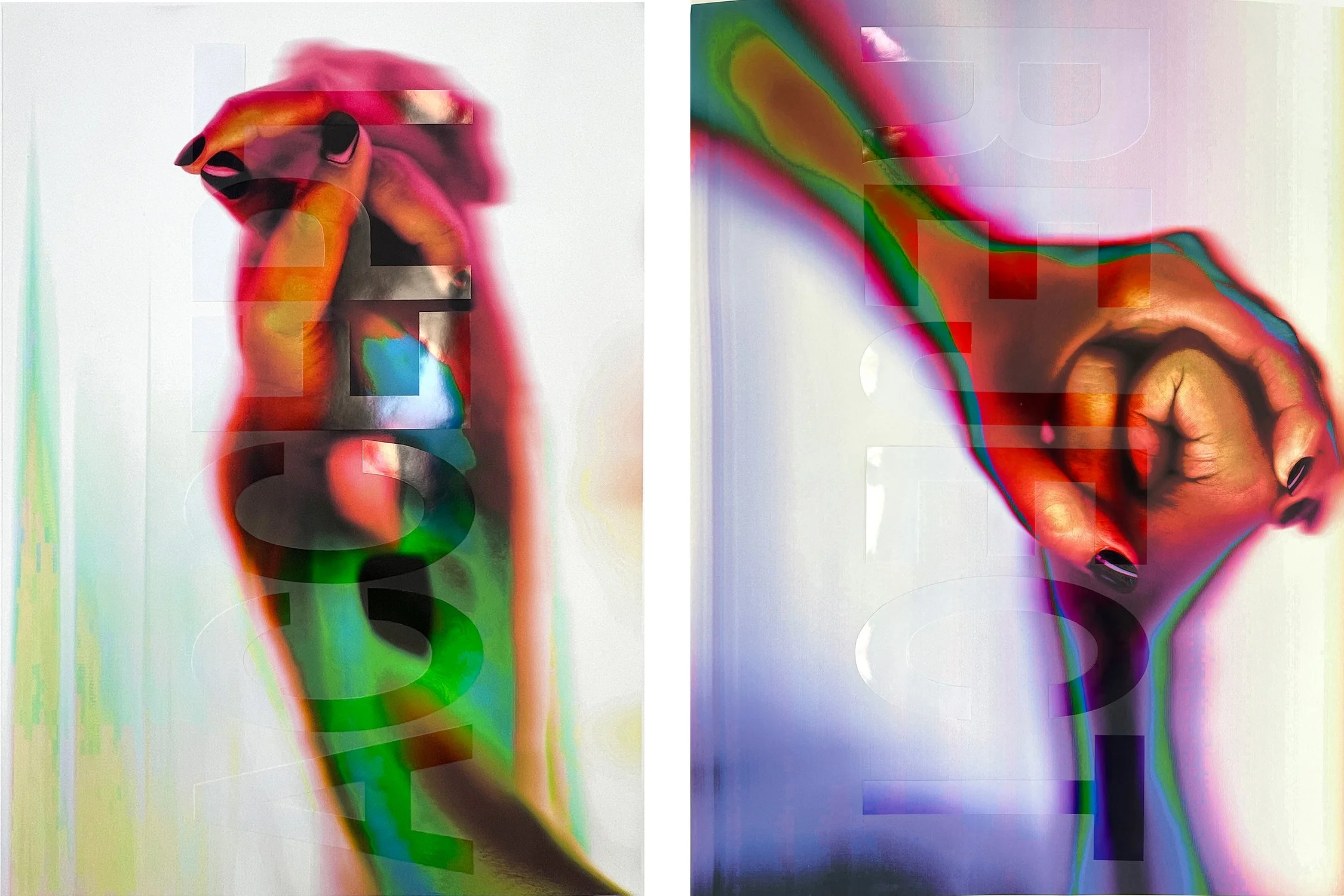
It’s also not about getting someone to see what I see, but to feel and imagine with me. Photography can be tricky like that—moving past the what to the why. My hands are making a gesture, but now they’re vivid purple.
I see painting creeping into my work—in color and in texture. Color, color theory, and cultural connections really intrigue me. White can symbolize purity, absence, and death at the same time. I love that the viewer gets to choose. There’s similar symbolism in tech that feels universal across platforms, but the icons shift over time and with context. Painting also carries the mark of human participation. I’ve painted substrates before printing, or scanned in painted layers to build texture. I’ve even pressed my body onto the screen, creating prints and smears that later become texture layers.
MK: I was looking through your website, and it is wonderful to see the throughline from collection to collection. I wonder, though, once you’ve achieved finding your particular style or voice, do you ever feel the need to break out and follow a different path?
AR: A mentor once told me, make everything. I was struggling to find the aesthetic to match my ideas and was exploring everything from painting to assemblages, fearing I’d never land anywhere. It was good advice. I created a lot of bad work and left many projects incomplete, but it really fueled my creativity. I still keep that practice. My studio is sheer chaos right now. I have a couple of collages, a painting, and a stockpile of collected objects waiting to become my nothing-somethings. Currently, I’m following a tangent I started five years ago that is only now starting to come together.
FU, from Merging Dimensions
LUV, from Merging Dimensions
Me, Me, More Me, from Merging Dimensions
Emergence, from Merging Dimensions
Pacify Yourself, from Merging Dimensions
MK: It’s so true that failure is such a benefit to artists. I often wonder if other professions gain anything from it in quite the same way.
You mention your studio being in chaos, which begs the question: What does a typical creative day consist of for you? Do you consider yourself a workaholic, or do you keep a schedule for family, socializing, vacation, etc.?
AR: Hmm, I’m now considering other areas to engage in productive failure.
I live by my calendar. Not that I’m a workaholic, but rather I tend to have chronic FOMO. I work in intense bursts, and when my art gains momentum, it’s hard to balance other things. I use every free moment—staying up late and working most of my weekends. After a while, I step back and shift to other commitments, though they often still overlap. For that reason, spreadsheets and deadlines are crucial to keep me moving. I’ve been known to sneak away on vacation and work on an image or submit an application.
One thing I wish I had understood earlier is how much time the business side of art requires. I think that’s why pure studio time is so precious to me. For me, a good creative day usually includes both reading and making. While many of my ideas grow out of research, I often spend an entire day absorbed in one stage of the process before switching to another.
I don’t know if you have an annual cycle, but I’ve found that my creative rhythm closely follows the seasons; I gear up in spring and start my resting phase in early winter.
MK: Oh, my freelance life doesn’t understand the word schedule. Time management is my eternal struggle.
Once again, you’ve touched upon a question I often ask, which I think always brings productive answers. It’s the “what do you wish you knew at the start” question, and learning the business side of art is definitely crucial. More need to pay attention to that, most certainly. So then maybe I ask instead, since it’s something we always need to address: What is it that makes a successful photograph? And this is specific to you and your work.
AR: I hate that I’m saying this, but it’s true; it just feels right. I’m often playing with soft focus, balancing clarity and ambiguity in my work to create a sense of wonder. The nature of my process embraces chance, so I’m always looking to be surprised. The photograph becomes successful when the image goes beyond the colors, texture, and formal elements to create something a little unpredictable. I know I’m on to something when I get past the details of how I made the work and begin to wonder; about color, a feeling, what’s there, or even what’s missing.
Deep Stream Intake, from Consumption Device
Rendering Pleasure, from Consumption Device
MK: What about collaboration with others in your work? I do believe that even the human elements represented in your images are you, is that correct? Does anyone else come into the picture, so to speak, at any point in your process?
AR: Yes, they are all images of my body, thus far. I’ve worked with others to program small devices and help me navigate scale. Sometimes, when I've looked at images on screen for so long it’s hard to imagine them in print. It helps to have another set of eyes to flip through test prints and imagine other outputs. I’ve also just started to incorporate others into my images, so we’ll both have to see how this ends up! However, at this point, I can say it’s created an unexpected space for intimacy and performance that the collaborators and I may not share in our day-to-day interactions. For me, that’s the joy of the process; playing off each other’s ideas and finding something new along the way.
MK: I have to say that not one person I’ve ever asked has said that collaboration was futile or a bad idea. It always turns out to be a positive. And now you mention seeing images on screen versus in print. That begs the question: Do you find that certain images work better in an exhibition, a book project, or even in an online capacity? Do you ever leave any out because you feel they might not be as strong in one venue compared to another?
AR: Oh yes, there’s a weeding process for every exhibition. It’s a question of interaction: how do I want the viewer to engage with the work, and how does the space allow that to happen? The online space lets me think about visual order and group cohesiveness, while the gallery allows me to consider spatial interactions, both between the viewer and among the works themselves.
The tactile and assemblage pieces are only fully realized in exhibition. They need the viewer to see more than what a photo can capture. For example, one work unexpectedly became about how people repositioned their bodies to accommodate an embedded screen. Those unforeseen moments and transformations are the most exciting part for me, so I really think about which pieces are right for each space.
I also consider scale. Online and in print, all works occupy the same visual space, which gives me more freedom in selecting pieces. I can create a sequential visual story. In exhibition, on the other hand, some of my works are quite small, and I can create a greater impact by drawing the viewer into an intimate space. I can also enhance the intensity by printing larger than life, letting the color and image loom over the viewer.
Hallowed Be Thy Frame, Adoration
Sacred and True, Adoration
MK: Clearly, excellent editing and observational skill when working on new imagery as well, no? So, as we wrap this up, I have to ask: What is next for you? Is there anything new or significant you wish to tell us about concerning your art? A new or expanding project, maybe?
AR: Ha! I like to think I’ve honed my editing skills in the hundreds of images that will never make it off my hard drive. Over the next year, I’m focusing on a project that I started a few years back, exploring how people of color are captured by the camera and surveillance systems. I’m documenting family and friends in a series of portraits that comment on clarity and the ability to be seen. So far, they are haunting and beautiful, and I can’t wait to do more.
MK: Now, as a final question for you, Anna: Is there anything you’d like to bring up that you wish I’d asked about? Or maybe something you wish to impart to others about your work or process that I may have missed? And with this, my thanks for your time and wisdom in joining me for this informative interview.
AR: Nina Simone famously stated, "An artist's duty, as far as I'm concerned, is to reflect the times". That has always resonated with me. My experiences have compelled me to join the conversation about the social effects of tech and our devices. However, in doing so, one of the biggest challenges to my work is keeping up with the pace of change. Learning new hardware and software requires attention, but understanding the larger social changes and keeping up with the discourse and trends can be daunting at times. My work serves as my record of living in this time of innovation, change, and uncertainty. For me, it is intense, beautiful, hopeful, and terrifying.
You can find more of Anna’s work on her website here.
All photographs, ©Anna Reed