Amanda Marchand
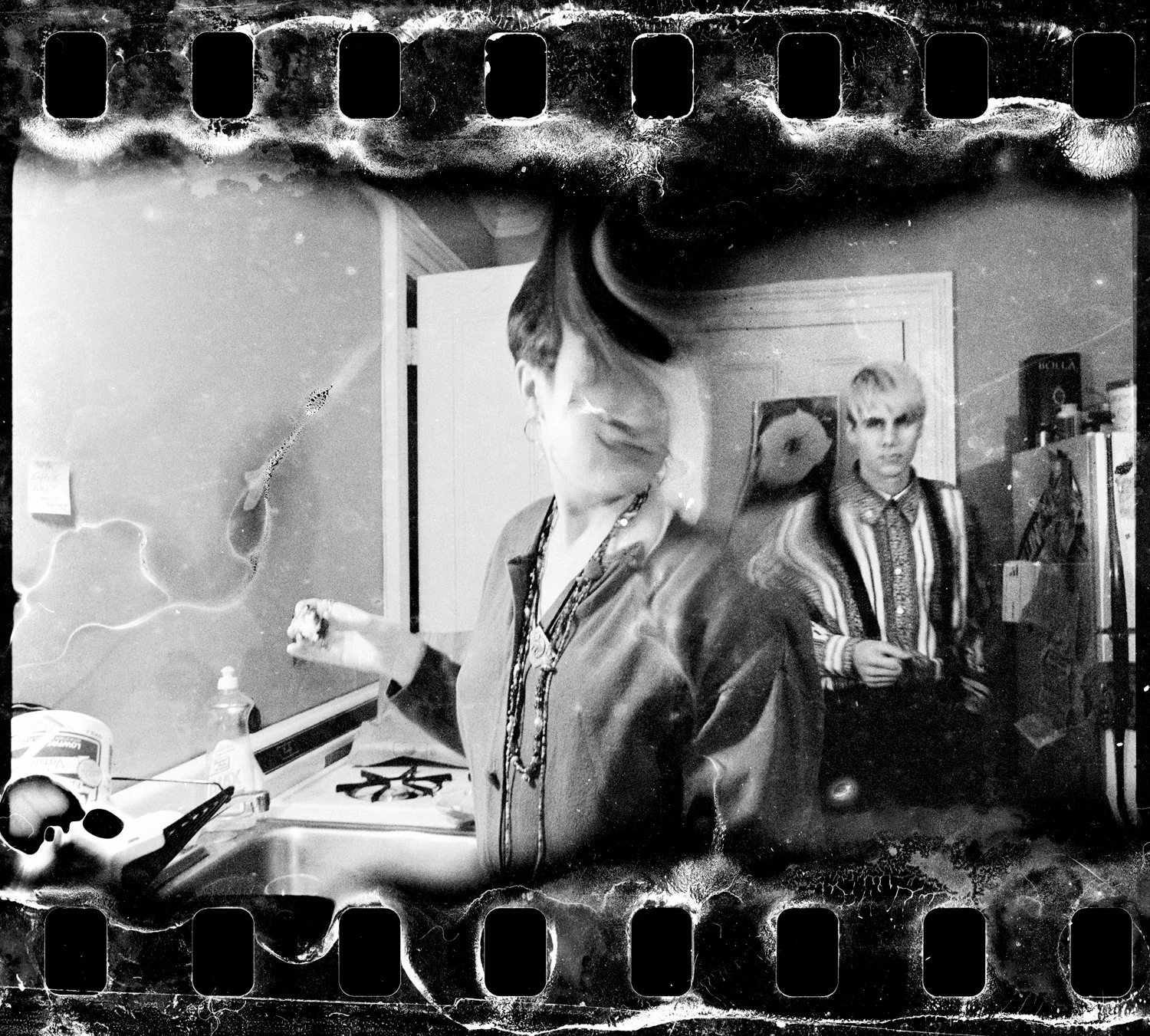
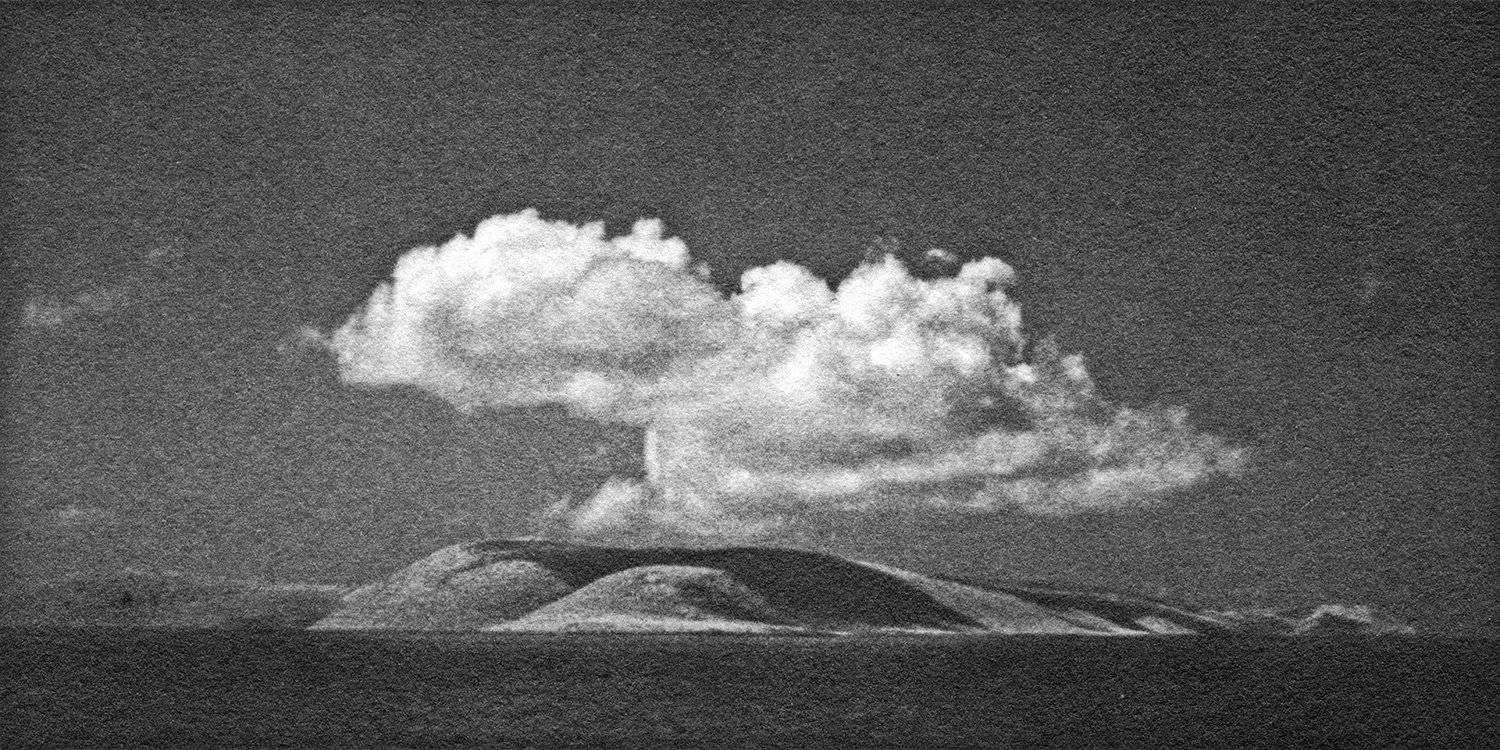
Canadian-born and Brooklyn-based photographic artist Amanda Marchand is busy exploring. In her words, she “explores the human condition with a focus on the natural world and an experimental approach to photography.” While holding an MFA from the San Francisco Art Institute and being the mother of two teenage boys, she poses the never-ending question of “what is a photograph?” This is the basis for her exploration of a medium that started out using traditional film and camera combinations but later morphed into the study of cameraless work, particularly lumen printing.
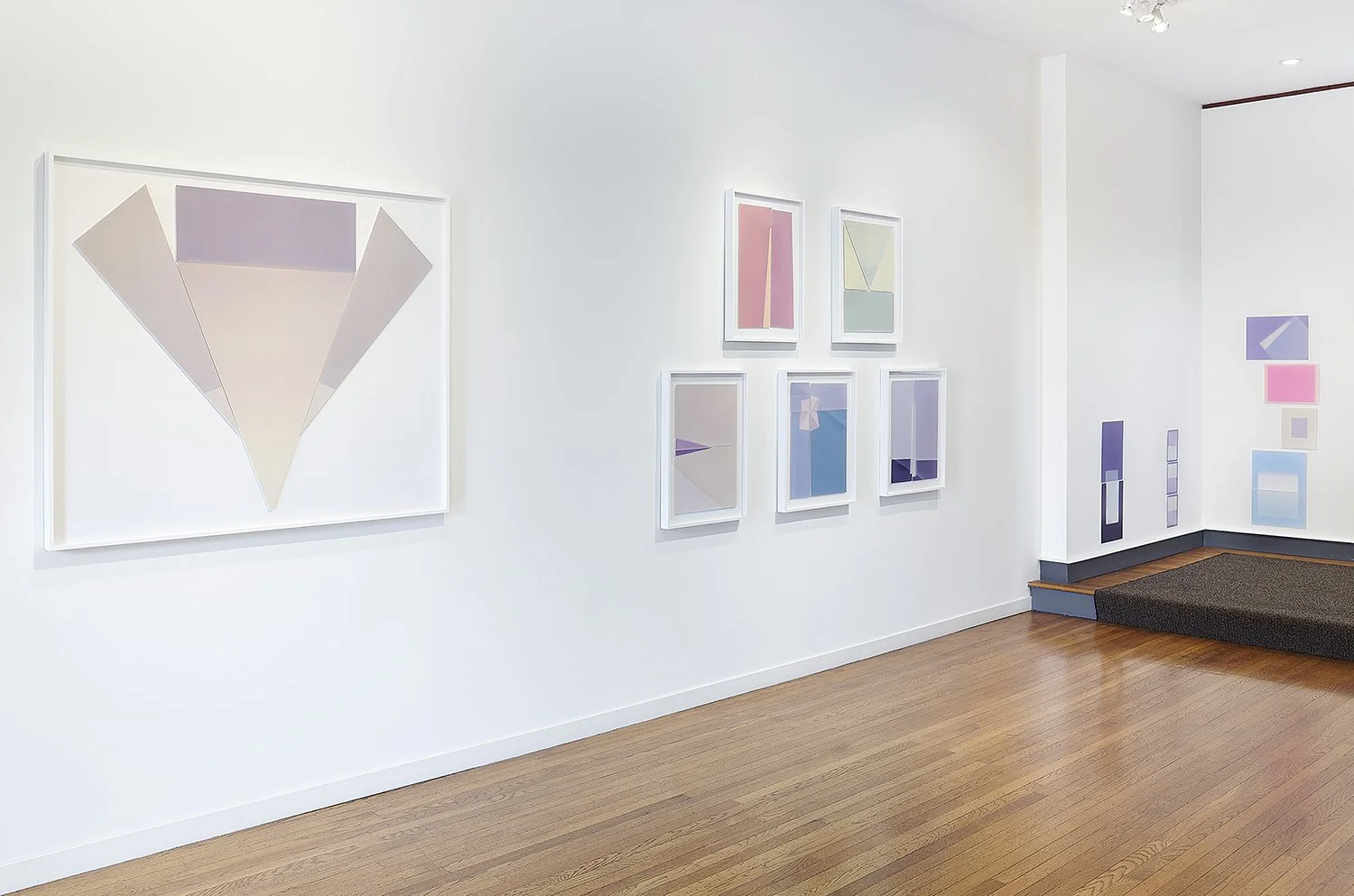
The proper word to describe her work would be poetic. Poems and prose quite often punctuate her work, especially in book form, bringing her penchant for the written word, design, and image-making to her monographs and artist books. The tactile nature of her photographic practice, from the extraordinary designs of her books to the finished sheen and glow of her lumen prints, presents us with objects of exceptional interest and beauty.
There’s a lot to unpack and learn from her, as Marchand has an incredible amount of experience from the years of fascination for the mediums that inform her images. Continuously changing and evolving through processes that feed her concepts, she is prolific and seemingly unceasing in the creation of her art. She is an artist always searching to find the best course of action to answer her eternal question. With this point, we want to present to our readers an artist who has spent the time, done the work, and has some thoughts on just what a photograph could be.
Bio -
Amanda Marchand is a Canadian, New York-based photographer whose work focuses on the natural world with an experimental approach to photography. She has been recognized as a fellow at the Hermitage Artist Retreat, MacDowell Colony, and Headlands Center for the Arts. Recent honors include the 2024 LensCulture Awards, the 2023 Julia Margaret Cameron Photography Awards, the 2022 Silver List, Medium Photo Festival’s Second Sight Award in 2021, and Photo Lucida’s Critical Mass Top 50 in 2021. Marchand is represented by Traywick Contemporary and Rick Wester Fine Art. Her work has been reviewed in ARTnews, The Marginalian, LensCulture, Aint’ Bad Magazine, Fraction Magazine, among others, and is part of the collections of the Getty, the San Jose Museum of Art, the Glen MUHC Hospital, Stanford University Library, The New York Public Library, and the Cassilhaus Collection.
Interview -
Michael Kirchoff: Thank you for joining me here, Amanda, it’s a pleasure to get to know more about you and your work. I wanted to start off by asking about what got you into the photographic arts. Was there a specific person or event that set off this spark in you? What about early influences?
Amanda Marchand: Hi, Michael. Thank you–I’m delighted to chat with you.
Early on, my time was split between writing and photography, but there are a few key things I can point to. When I was 16, my grandfather gave me his Rolleiflex camera. Then, studying literature at university, I signed up for a key to the darkroom and spent countless hours printing, then plastering my walls with photos. But the spark really happened when I was 23 and at Emily Carr College of Art and Design. I was taking a class with photographer Sandra Semchuk. She spoke about the darkroom being almost a sacred space where one could not only develop photographs but develop a part of yourself in a much deeper sense... she announced that entering the darkroom was a kind of portal, and insisted that we look at our fresh negatives with no distractions. She directed me towards the San Francisco Art Institute to study with Linda Connor (a mentor and friend ever since), and where I did an exchange semester, then eventually, grad school.
MK: In going through much of your work, it seems that while you are staying open-minded to the materials you use to create images, the darkroom is still often the place where you can be found. Some of your work is a hybrid of photographic technologies, and some are strictly analog. Do you feel that this connection to analog, alternative, or historical processes is paramount to your work? Is there a favorite method that you prefer?
AM: I would say that most of my work has a hybrid nature. My approach to photography is rooted in theory and process and in thinking about the medium of photography. The question, “What is a photograph?” is central and directs each project in a different way. While I love the darkroom, I have a chemical sensitivity, so I’ve always had to find ways to limit that. I’m very comfortable borrowing from everywhere, literature and other mediums, as well as different ways of working photographically. I use the medium democratically–everything is a tool to make the best work possible–analog, digital, alt process, even iPhone or scanner, etc. I’m fascinated by genre in that sense, “deconstructing” the medium, with all its varied instruments, and the history that is tied to each, recontextualizing within the present day. So, for example, while I have been working with lumen sun prints for five years, which is generally an analog darkroom process, I have intentionally incorporated a scanner to “fix” the fugitive lumen colors. I like how the scanner adds to this larger existential question I’m interested in about time, merging new technology with a very early, and in some ways still nascent, photo process.
MK: I love that you use all of the tools at your disposal. I’m also glad you brought up lumen printing because I wanted to know more about how and why you have chosen that process to create multiple bodies of work, and of different types, from straight printing to installations. It’s also apparent that using lumen prints as graphical elements to create the larger piece is a large part of your current practice. What drives you to use this way of making cameraless photographs as such a key element of your creative process?
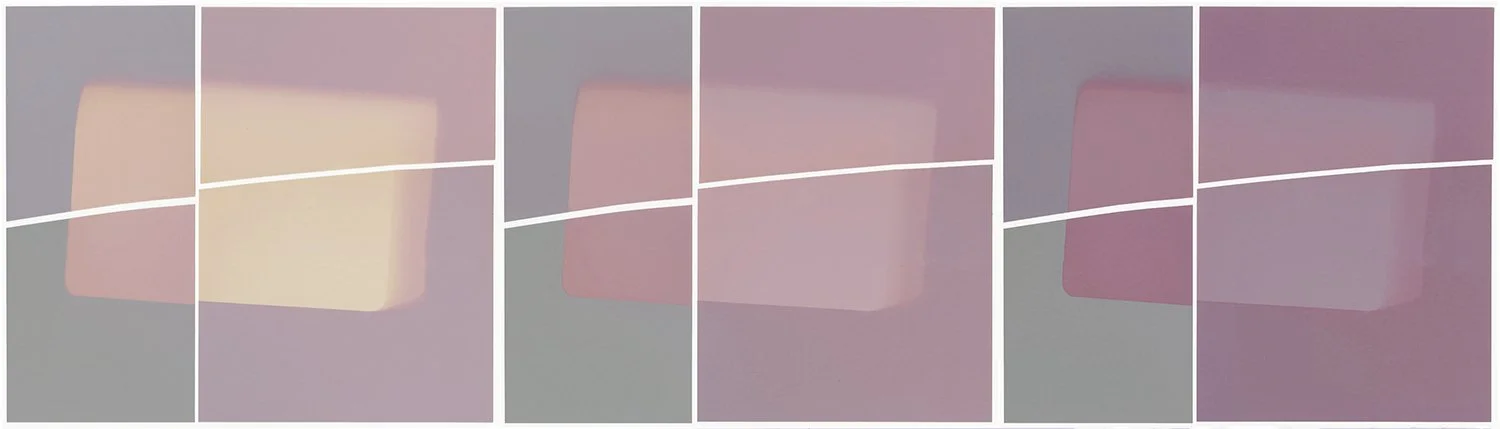
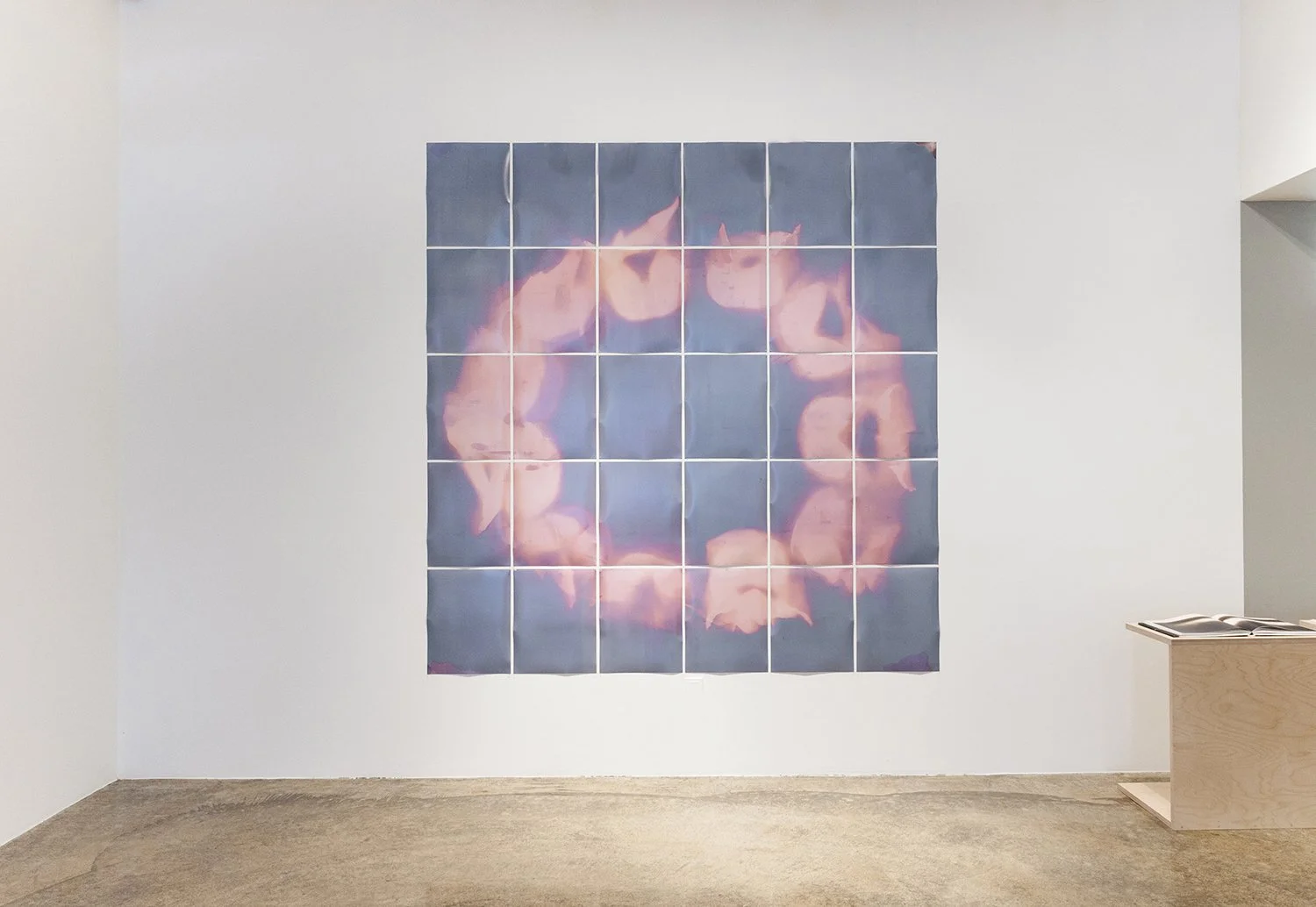
AM: The lumen work came at a very specific time. I had been to a residency in Finland a few years before, where I started using the camera as a tool for being more present in the world, actually meditating with it on my lap and breathing/counting while taking photos… I was wanting to align life and art, to see if there could be less separation between the two. Then, when Trump was elected, it felt as though, overnight, it was a different world. The divisiveness, turbulence, and tear in the fabric were palpable. I felt, I think, like many artists, I couldn’t keep working in the same way. So, around the time of the inauguration, I made my first camera-less lumen piece, a large 11 x 11-foot meditation circle at the San Francisco Art Institute in conjunction with my gallery, Traywick Contemporary’s 20th Anniversary programming. I wanted to focus on what we all share rather than what separates us–I wanted to bring people into this circle, to sit and mark time on the planet together, regardless of political affiliation, gender, age, religion, etc. Working with that first large lumen print, I fell in love with how the color of black-and-white paper continues to shift when exposed to light. Each paper brand and finish has its own color alphabet, essentially.
The fugitive lumen process produces changing colors that are destroyed by chemical fixing. I began to identify this very simple process with everyday flux, our own impermanence, as well as connect it to the evolution of the medium of photography, the evolution of the species, climate shifts–time, in essence. I kept doing the same thing over and over–marking the photo paper in the sun (a part of that meditation practice: counting out time). I started out photogramming with photo envelopes/boxes, then quickly moved to books. I was curious about starting a photograph with a title, which usually comes last. At one point, maybe three years in, I figured out that I could stack these lumen (book) images like the piles of books in my bedroom and studio. There has been a through line in my work of verticals and horizontals, and I’ve been able to play with that syntax visually on the wall with the lumens, with the individual pieces as kind of building blocks.
MK: Lumen printing has become a very popular process to embrace for many these days, though you seem to have explored it more thoughtfully and thoroughly than most. You mention the colors achievable with this process, and as a little side note, I’m wondering if you have a favorite or preferred paper to work with? The analog crowd out there would love to know. (Okay, okay, so would I.)
AM: Yes, it is popular now! When I started working with lumens, I had never even heard of them… my friend Leah Sobsey, a photographer I’m now collaborating with on a new project, turned me onto it. My favorite paper has been Adorama, either Fiber-Based or Resin-Coated, though the fiber has a wider tonal range. The glossy is harder to scan because it is so reflective. This paper has a lovely, long range of yellows to pinks and peaches at the start of the color change, as well as some light purples and purpley blues in the longer time range, and then dark blues, and ends up an almost silvery gray when you max it out. The color change reminds me of a sunset. It’s also currently being fabricated, so it's easy to find. Another paper I love and am using sparingly because it’s expired is Kodak Polyfiber FD paper from the ‘80s. There’s a lot of silver in that paper. The darkest tones go almost black (though a bit blue-black). It’s slow to change color, which gives flexibility when printing, but that means you have to be patient with it. Many of the expired papers I’ve used are slow to respond to light. I was gifted three of these old boxes by Gerard Franciosa, who runs My Own Color Lab in Manhattan, where I print my exhibitions. But each photo paper is quite different; I recommend playing around with a few since the results can be dramatically different.
MK: It seems as though I’ve heard that the older papers, most, if not all, expired, always produced better results due to the amount of silver in them. However, it sounds as though that’s not exactly true. I think it’s good to hear that exceptional results can be achieved with papers currently being manufactured. Now, you brought up collaboration with Leah Sobsey. This is not the first time you two have worked so closely together on a project. Is that true? Is collaboration an important part of your creative process?
AM: Leah and I were in the MFA program together at SFAI, but it's the first time we’ve collaborated. Collaboration feeds my personal practice. Everything I do artistically, except for residencies, can be so solitary, so it really feels essential to my energy and longevity as an artist. The first two collaborations were with my friend Jeanne Quinn, a brilliant ceramic artist I met at the MacDowell Colony. We made a body of work called 3 Ways to Say I Love You for an exhibition at Scripps College. The work combined photography and ceramics in different ways related to reproduction, biological, and artistic. Then, a few years later, we gave ourselves absolute freedom and worked on a children’s book.
This one with Leah uses a very slow printing process called anthotype (a plant-juice sun-printing process). I’m especially appreciative, in such a big undertaking, that we both bring different strengths to the table, and that’s been a way to keep each other afloat. It’s been especially nice during the pandemic to be so connected and working through the same set of problems together. There are two other artists I’ve agreed to collaborate with eventually... art time moves slowly, so for now they are in the distance.
MK: How wonderful to hear about yet another exciting project. I’m definitely looking forward to seeing more. Now, as an extension of my collaboration question, I wanted to bring up the creative aspects of working with book publishers. You’ve made some incredibly lovely books in the past, so I’m wondering what that process is like for you. Also, does every project deserve a book, or is that always the initial feeling?
AM: Books are a huge part of my artistic practice. I am often working on multiple projects at once, and they usually don’t feel necessary until they take shape as a book in my mind. I don’t think every project deserves a book. But for me, work doesn’t really make sense unless I’m figuring it out as a book, generally. I think there’s a certain amount of excitement, and then, momentum with books. It’s a fascinating and difficult puzzle. It’s a concrete structure that is endlessly pliable, physically and conceptually. Books are great for serial imagery, and I’m often working in diptychs or triptychs or sequences, with the element of time. Books pose interesting challenges sculpturally, and they are perfect for text, which is something I’m always playing with. Also, I find that photo books, if you are successful, add up to much more than the sum of their parts, with their intimacy and materials. That’s the goal, anyway.
I’ve been incredibly lucky to collaborate with Datz Press on multiple occasions. We published two books together, Night Garden and Nothing Will Ever be the Same Again, and they have fabricated parts of my other artist books. For the publication of Nothing Will Ever be the Same Again, I was invited to do a residency at Datz Museum of Art in South Korea. They have an artist residency program by invitation. You are given a studio space and a place to live near the museum, an hour outside Seoul (where the press is). I spent the whole month of July there. We worked with my original dummy, really delving in–deliberating paper type, paper color, book size, font, binding, gatefolds, tipped-in prints, cover, etc.–really, how a book goes from an idea to a thing. It was a dream come true. Everything they make is pure magic, as you probably know. It was especially incredible because of all the support, and the ability to talk through ideas with the designer, Xianlu Yi, and project manager, Juyoung Jung. The museum is on a mountainside. There is a huge organic vegetable garden for the kitchen, enormous kimchi pots outside, and the most incredible cafe. Sangyon Joo, who runs the whole outfit, is a visionary. She’s an artist, a designer, so talented and generous, a dear friend, and an inspiration to me.
When we weren’t working on the book, I worked on a project titled No Title Required. It was [during the] Me Too movement days, and I was inspired by the fact that they were basically an all-female team of 10 at the museum and press. I asked the staff to select books with their favorite heroines, be they real or fictional. Then I make lumen sun prints with the books they brought. What was really interesting was being able to connect more with each of the women. For some, language was a barrier. But I was able to get to know more about them all with the project, their affinities, their family life, and stories through the books they chose. It was incredibly meaningful.
MK: Such a wonderfully collaborative effort from everyone involved! The time and effort really show in the end result. It seems that artist residencies are your happy place. You appear to get so much done with your time–a thoroughly focused endeavor. Clearly, another part of your own creative puzzle, would you agree?
AM: Absolutely. I owe the fact that I am still an artist today to residencies. They have given me so much support. I’m incredibly grateful. My first residency was at the Headlands Center for the Arts in Marin, CA, by the Pacific Ocean, where I was given a year-long studio, and then was able to stay on a second year as an affiliate artist. That was especially helpful just out of grad school. That was followed by the MacDowell Colony, another amazing one. I delivered my first son two weeks after I left, so I was very pregnant there! Then it was another 10 years until my next one, in Finland, at Arteles Creative Center. After that, I realized how crucial it was for me, for momentum, for connection, inspiration, and the ability to do a deep dive. One of the best surprises was an envelope in the mail, with seashells and sand and a card welcoming me to the Hermitage Artist Retreat in Florida. You don’t apply, you’re just granted a bank of six weeks to use as you wish.
While a key part of residencies is the work you make, their true brilliance is that they can bring such a diverse group of creatives together: choreographers, poets, photographers, playwrights… a person painting with fire, someone making a real-life rollercoaster based on emotions, a flautist performing to her amplified heartbeat, another artist working on a comic book, someone “being snow,” award winners and emerging artists, all ages and from all over. These places can be incredible crucibles of ideas, experimentation, discovery, sharing, and sometimes even include naked saunas! The artists I meet open my mind to possibilities and have definitely impacted my work, helping make it stronger.
MK: That impact seems very apparent. In fact, I notice your use of the written word showing up with the imagery, specifically poetry, and also integrated into the design, like with your dreamy book Nothing Will Ever be the Same Again. These influences substantially expand the scope of the work, not to mention your process in general. Can you address this a little more?
AM: I studied literature as an undergraduate and published a novel with DC Books (Canada) when I graduated from SFAI. I had been writing and making photographs in tandem for about a decade. That novel is very visual stylistically, imagistic. For me, writing and photography are both ways to see what I am thinking and know deep down, but they access knowledge a little differently.
Photography took over as the dominant practice when I had my children, but writing still plays a large role in my creative process. The two books I made with Datz both incorporate text, poetry really. In Night Garden, words hint at the larger story, leading the viewer in an open, suggestive way, hopefully. At the end of the book, there is additional text that situates the Night Garden within illness and transcendence, but the handwritten words in the book act as whispers in the dark.
In Nothing Will Ever be the Same Again, the only text is a part of the book’s physical structure, hidden in the slipcover. I liked that you may not find the words for a while, maybe not even until years later, but that they provide a second, parallel reading, a deeper reading. By looking more carefully, you will find this second layer, and this work was really about stripping away layers over a one-month period, through absolute presence. The photographic sequences in the book are subtle, a slow burn, so I felt that text on the same page would have eclipsed them. The slipcover text reads as a poem, running the length of two pages, but beside each line is a legend. You can locate each line in the book, so this also functions as a list of titles.
I think that text and image operate in two separate parts of the brain. I find it’s challenging to combine them successfully. You don’t want one to dominate or explain the other, and that’s the way they are often used. I keep trying to work with them because they are both such a part of me–of the way I tune into the world, and because when I see it done well, it’s a whole other level. Alternately, in Lumen Notebook, it’s been a way of coming back to writing, in a sense, since each image is bound by language, brought into being by language (the book title). Sometimes I think this body of work is more of a writing project than an image project.
MK: So you really have gone full circle to your beginnings with an interest in both writing and photography. Your connection of the two seems very appropriate and handled exceedingly well. I wanted to go back to the lumens for a moment before moving on to a few more general questions about your practice. With the lumens, or any of your work really, are you working in a planned, mindful way, or does intuition take over and guide you to a finished piece?
AM: I am working intuitively. I like to joke that I make my work while I’m asleep, but it’s true. I wake up in the morning, and I know things. Or things come at me sideways, particularly when I’m exercising. I’ve learned to trust that. If I have something all figured out while I’m working on it, that’s a warning signal. Really, the secret is to just keep working, the labor part, to make a lot of work, and then a lot more, in the darkness (metaphorically–and well, literally), and eventually, all will be revealed.
MK: That’s an informative take on how you work. I have to ask as well, anyone working in an artistic field has matured and grown over time. Is there anything you’ve discovered lately that you’d like people to know about you or your creative process?
AM: That’s such a large question! Where to start… Well, there are a few hurdles in this field, so you become adept at working with rejection or failure and befriending them. I think there have been a lot of great lessons there for me. So in your question, I am really thinking, what might younger artists or those starting out benefit from knowing, what did I need to know early on? I wanted to learn how does an artist make it happen, cobble it together, what does that life look like, what is the personality, the toolkit, the environment that fosters that creative life. I personally absorbed that by going to graduate school, but that’s only one way. From the writer Kathy Acker, with whom I studied at SFAI in my twenties, I learned: Go land on someone’s doorstep you admire and refuse to leave. She did that with William Burroughs–she rang his doorbell and stayed. I don’t know why that story gave me permission, but it resonated.
In keeping with that, I’ve stayed close to some of my teachers. But modeling and connection, and community are very important aspects of this vocation. I am still close to Linda Connor, and was very close to the artist Anne Chamberlain before she died; I worked with her on several of her projects. This kind of relationship has been invaluable. I worked for a few years assisting Jim Goldberg, and I know how serendipitous that was, absorbing how he worked on his book drafts. I would add that it’s been invaluable to have a critique group; this doesn’t have to be a large number of people, but these are folks who support you in a circle of trust and mutual respect, and share your triumphs and defeats and see you when you feel stuck or lost and cheer you on no matter what.
Lastly, it seems obvious, but if you do this one thing, then you are good to go, and that’s just to do the work you need to do. Make exactly what you want to make, even if it’s too sentimental or pretty or not in vogue or too vulnerable. Especially if it's too vulnerable. That’s the only way you’ll get to where you are going. And build support for yourself, create accountability. I work with artists now, in a coaching/mentoring capacity. It’s very rewarding watching their projects as they come to life over time. Professional practice is something I really enjoy, tips and tricks in the real world as well as with the psyche. The art world is always a mystery with its many rules and non-rules. It’s a privilege to be a part.
MK: That’s a lot of great advice and inspiration, based upon years of hard work and experience. This brings about the question of what a typical creative workday might look like for you. Is there such a thing?
AM: Right now, a workday includes meditating one to two hours a day. That’s been the only constant for the past few months. It really depends. Sometimes I am writing a lot, residency applications, grant applications, working on the computer, post-processing images, placing my books in collections, researching, ordering materials, planning a show… But sometimes, for big stretches, I am making new work. It’s a juggle. At the moment, I have three days a week that are set: a photo-lab day in Manhattan, a day with my studio assistant, and a day mentoring artists. The other two plus a day on the weekend are spent fielding whatever is most pressing. And I’m also a mom to two teenagers. :)
MK: Ah, yes, motherhood, the biggest job of them all! Beyond commendable to juggle so much. So, when I read about how much time you spend with past work and writing to get that work seen more, I wonder if there was a specific point in time that you felt satisfied with the direction of your work? Do you ever truly find yourself in a good place with your images, or are you always searching for more?
AM: Hmmm. That’s a good question.
For me, it’s not about being satisfied. It’s the question of attending. I try not to separate art from life. Art is the life I’m living; it’s an extension of my day and my dreams at night, and my relationships. It’s a tangle of life and the larger world and the inner sphere of the heart and mind. Photography has become a little bit of a devotional practice for me, or maybe I would like it to be. And being satisfied would mean I’ve arrived. My relationship to photography is that of process, being in process with the materials and ideas, being in flux–aging, making mistakes, forgiving, tuning to, forgetting to, starting over, allowing for failure and trying, with some struggle, to accept imperfection–that’s the thrust. It’s no accident right now that my practice is simply sitting in the sunshine. Just that, sitting with paper and scissors and counting, reliant on the light from another star, our star, eons away, alighting on the paper, chemically reacting with it.
I rested for one summer in the darkness of a garden and wood, and found with the camera, unexpectedly, light. That shattered me. The metaphor of light in this medium is such a rich one. Photography’s cornerstones are light and time (aperture/shutter speed), but all aspects of the photo use that language. When I’m sun-printing, I’m attending to the moment, imperfectly. It’s a small gesture, but it’s changing the paper, and it's changing me. At the same time, a war is starting, the pandemic continues to devastate lives, economies, our planet’s health is threatened in a multitude of ways. What do marks on paper matter? They don’t. But the act of presence is important, today especially. We need to ground ourselves in order to bear the weight of things, maybe take action, or just love. Everyone is aching. That’s what I notice when I talk to my friends. Anyway, choosing the creative life, with all its insurmountables, it’s really about the seeking for me, not the landing, trying to get closer to something, maybe openness, maybe understanding, maybe surrender.
MK: Wonderful, I’m floored by this journey you’re on! Well, let me conclude this interview by asking you how you see your work progressing into the future. Do you have anything new you are currently working on that we should be on the lookout for? And lastly, thank you for your time and valued words with everything here–it is much appreciated.
AM: Thank you, Michael! It’s been a pleasure to answer such insightful and considered questions.
I have been bewitched by a new project I started at a Kala artist residency this year on "cunning folk" (witches), so stay tuned... For 2026, I also have several solo exhibitions of This Earthen Door, a 5-year collaboration with artist Leah Sobsey on Emily Dickinson's herbarium this winter/spring: A show at Gallerie XII in L.A., recently opened on January 31; a show at Staniar Gallery in Virginia, opening April 27; a show at Traywick Contemporary in Berkeley, CA, opening April 2nd. We have a solo booth with Rick Wester Fine Art at this year's AIPAD in New York in April, featuring new anthotypes that center on the N.Y. Botanical Garden. I'll be teaching a class on plant-based photo process this July at Maine Media (with Leah) as well.
(Updated 1/4/26)
*This interview originally published in Analog Forever Magazine, Edition 6.
You can find more of Amanda’s work on her website here.
All photographs, ©Amanda Marchand